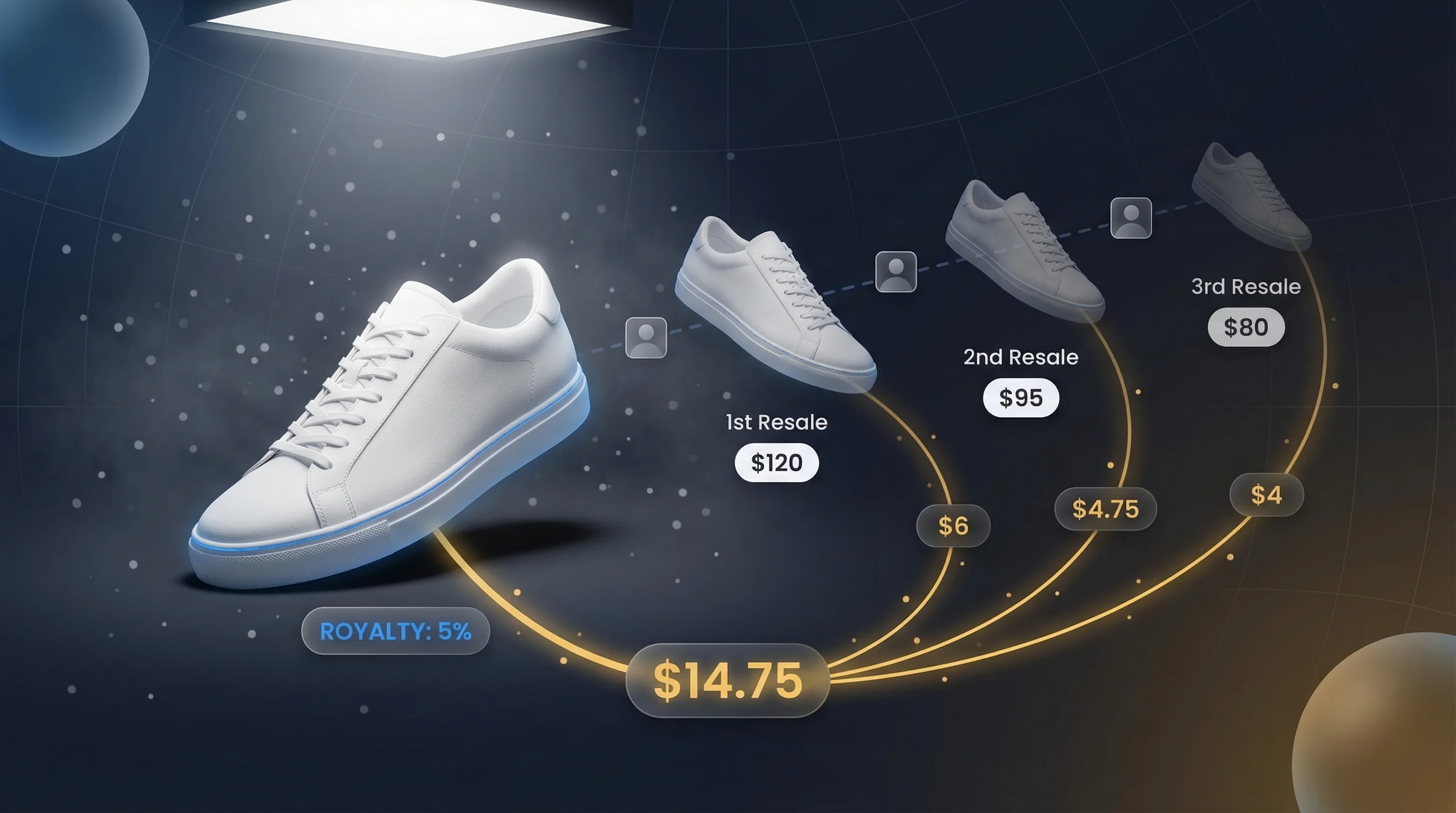
The global secondhand market was worth $594 billion in 2025. It’s growing at 13.6% annually. The secondhand apparel market alone is projected to nearly triple to $486 billion by 2031, growing two to three times faster than the primary market. Online resale now accounts for 88% of all resale spending in the US.
Your products are in that market. Right now. Being resold on eBay, StockX, Vinted, Depop, The RealReal, Facebook Marketplace, and dozens of other platforms.
How much of that resale revenue flows back to you? Zero.
Every time your product changes hands on a secondary marketplace, value is created and captured by everyone except the brand that made it. The platform takes its fee. The seller captures their margin. The buyer gets the product. The brand that designed it, manufactured it, and built the reputation that makes it worth reselling? Nothing.
This isn’t a niche problem. It’s a structural flaw in how physical commerce works. And Digital Product Passports are about to fix it.
The current “post-sale engagement” pitch is a distraction
The DPP conversation in enterprise sales right now is dominated by a familiar promise: post-sale customer engagement. The pitch goes something like this. Scan the product, land on a brand experience, drive repeat purchases, measure engagement rates, report a percentage uplift in return visits or email signups.
This is a marketing metric dressed up as a business case. It satisfies CMOs who need engagement numbers for their quarterly decks. It does not satisfy CFOs who need revenue on a P&L.
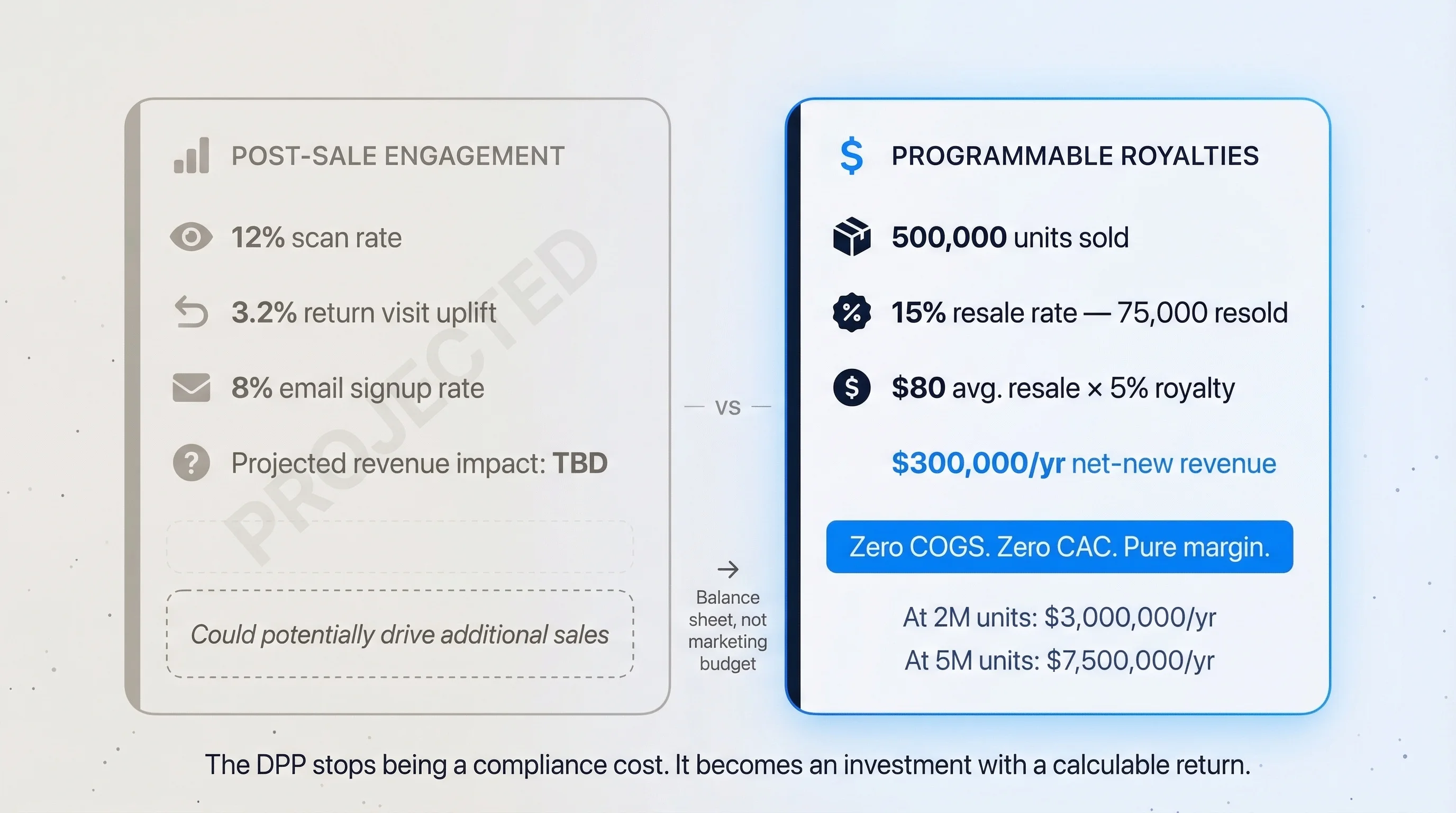
The problem with engagement-driven DPP solutions is that they measure potential. “X% of customers scanned the product” becomes “which could potentially drive Y in additional sales.” Could potentially. These are projections built on assumptions, not income.
There’s nothing wrong with post-sale engagement as a feature. But positioning it as the primary value proposition of a Digital Product Passport is like selling the internet as a better fax machine. It’s technically true and completely misses the point.
What programmable royalties actually are
Here’s what becomes possible when you tokenise a physical product into a programmable digital asset.
A Digital Product Passport, built on open smart contract standards, isn’t just a data container. It’s a programmable asset. The rules governing that asset, including what happens when it changes hands, can be encoded directly into its smart contract.
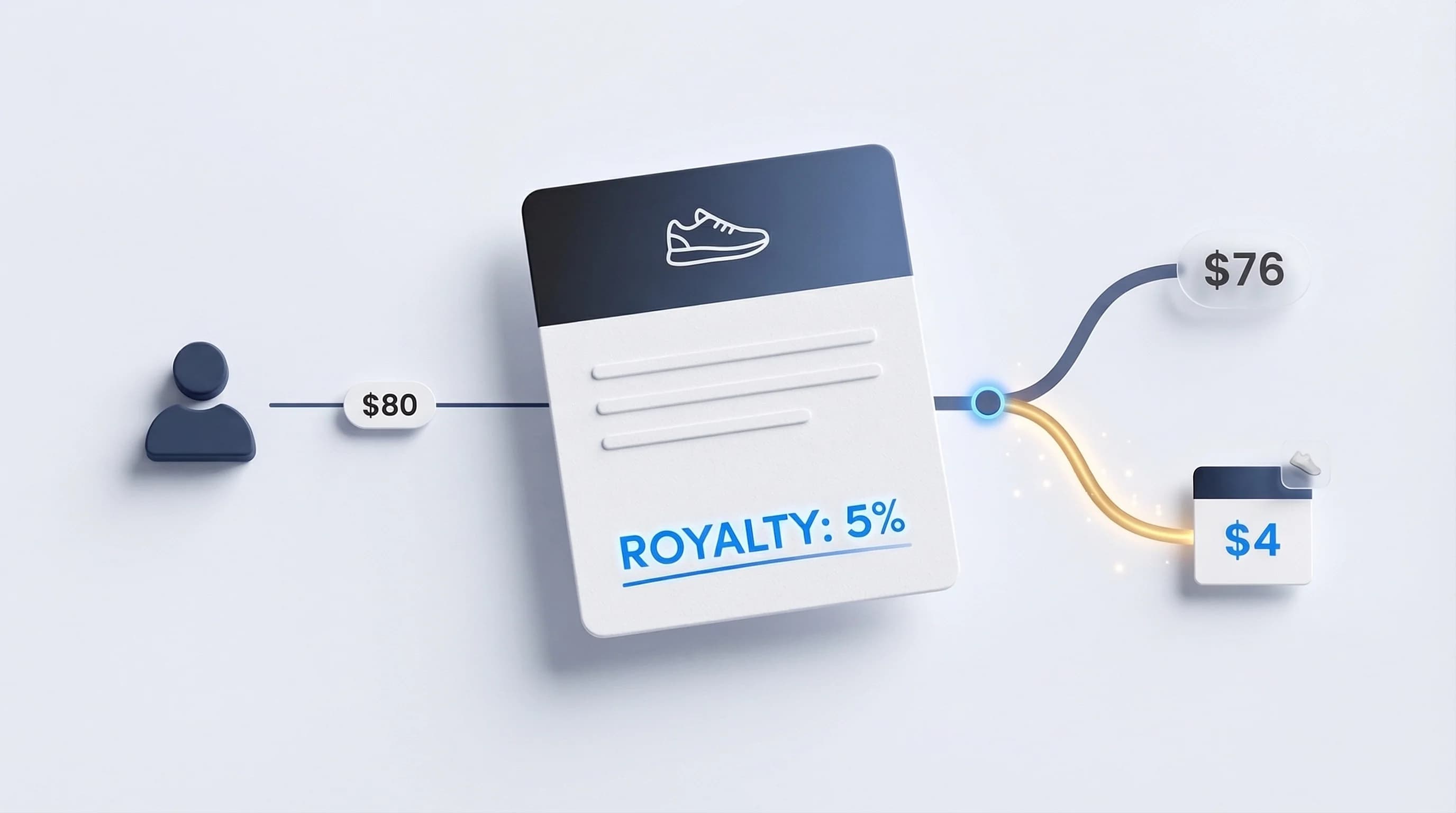
One of those rules: a percentage of every secondary transaction automatically transfers back to the original creator.
This isn’t a licensing agreement. It’s not a contractual obligation that requires enforcement. It’s mathematics. A line of code. When the product is resold on any marketplace that interacts with the Digital Product Passport, the royalty executes automatically. No invoice. No negotiation. No revenue leakage. The value transfer happens at the protocol level, enforced by the smart contract, not by a legal team.
The brand sets the royalty percentage when the product is tokenised. It could be 2.5%. It could be 10%. It’s programmable, meaning it can be tailored per product line, per category, per market. And it applies to every subsequent resale, not just the first one. Second-hand, third-hand, fifth-hand. Every time the product moves, the brand earns.
The maths that changes the conversation
Let’s make this concrete.
Take a mid-market fashion brand selling 500,000 units annually into markets with meaningful secondary activity. Assume a conservative 15% resale rate (industry averages for desirable fashion brands range from 10–25%). That’s 75,000 products resold each year. Assume an average resale price of $80. That’s $6 million in secondary market transactions annually from this single brand’s products.
At a 5% royalty: $300,000 per year in net-new revenue. Revenue the brand has never captured before. Revenue with zero additional cost of goods sold, zero marketing spend, and zero customer acquisition cost. Pure margin.
At a 7.5% royalty: $450,000. At 10%: $600,000.
Now scale that to a brand with 2 million units and a 20% resale rate, selling products with a $150 average resale price. That’s $60 million in secondary transactions. A 5% royalty generates $3 million annually. For doing nothing except programming the royalty into the product’s digital identity at the point of creation.
This isn’t engagement data that “could potentially” drive sales. This is revenue. It shows up on a balance sheet. A CFO can model it, project it, and include it in financial forecasts with the same confidence they’d apply to any other recurring revenue stream.
Why this has never been possible before
The reason brands have never captured secondary market value isn’t because they didn’t want to. It’s because the infrastructure didn’t exist.
Physical products have no native digital identity. When a product leaves the brand’s ecosystem and enters a secondary marketplace, the brand loses all connection to it. There’s no mechanism to track it, no way to verify authenticity at the point of resale, and no infrastructure to enforce a value transfer back to the creator.
Proprietary marketplaces like StockX and The RealReal built their businesses precisely on this gap. They provide authentication and trust as a service because the products themselves carry no verifiable identity. The platform becomes the trust layer. And the platform captures the economics.
Digital Product Passports invert this dynamic. When every product carries a verifiable, programmable digital identity from the moment it’s manufactured, the trust layer moves from the platform to the product itself. The product authenticates itself. The product’s smart contract enforces its own economic rules. The marketplace becomes an interface, not a gatekeeper.
This is what makes the royalty model structurally different from anything that’s existed before. It’s not dependent on a partnership with a specific marketplace. It’s not dependent on a consumer voluntarily scanning a QR code. It’s embedded in the product’s identity at the protocol level. Any interoperable marketplace that recognises the Digital Product Passport automatically executes the royalty. The brand doesn’t need to negotiate marketplace-by-marketplace. The economics are programmed once and enforced everywhere.
The CFO conversation, not the CMO conversation
Most DPP vendors are selling to CMOs. Engagement metrics. Brand experience. Consumer touchpoints. Post-sale marketing funnels.
There’s a reason for this: engagement is easy to pitch and hard to disprove. You can always claim that a 12% scan rate “shows strong consumer interest” without tying it to a dollar figure.
Programmable royalties flip the buyer. This is a CFO conversation. It’s a conversation about net-new revenue streams, gross margin expansion, and recurring income from assets the brand has already manufactured and sold. The unit economics are modelable from day one. The revenue scales linearly with secondary market activity. And the cost to implement is a fraction of the value captured.
When a CFO can model that a 5% royalty on secondary transactions generates $300,000 to $3 million annually, with zero COGS and zero CAC, the DPP stops being a compliance cost. It becomes an investment with a calculable return.
That’s the conversation that gets Digital Product Passports onto the balance sheet instead of the marketing budget.
The compliance-to-revenue pipeline
Here’s the strategic frame that ties everything together.
The EU’s ESPR is mandating Digital Product Passports for roughly 30 product categories between 2027 and 2030. Every brand selling into the EU market will need to create a verifiable digital identity for every product. That’s a compliance cost. It’s unavoidable.
But the infrastructure you build for compliance is the same infrastructure that enables programmable royalties. The DPP that satisfies a regulator is the same DPP that can carry a royalty smart contract. The tokenisation that creates a compliant product identity is the same tokenisation that makes that product a programmable asset.
Compliance is the wedge. Revenue is the outcome. The brands that understand this will build their DPP infrastructure with both objectives from day one, turning a regulatory cost into a revenue gateway that compounds with every product they manufacture and every resale that follows.
The brands that don’t will pay for compliance, check the box, and continue watching billions in secondary market value flow to everyone except them.
James Albarracin is the Founder & CEO of Family Labs, the company behind the Universal Goods Protocol, open infrastructure that tokenises physical products into programmable digital assets via EU-compliant Digital Product Passports.