
In January 2026, Google CEO Sundar Pichai stood on stage at the National Retail Federation and announced the Universal Commerce Protocol. An open standard for agentic commerce. Shopify, Walmart, Target, Etsy, Stripe, Visa, Mastercard, and over 20 other companies co-signed it.
Two months later, Mastercard and Google launched Verifiable Intent, a cryptographic trust layer that creates tamper-resistant proof of what a consumer authorised when an AI agent acts on their behalf.
These aren’t research papers. These are production systems being deployed right now by the companies that control the infrastructure of global commerce.
The message is clear: the next era of commerce won’t be navigated by humans clicking through product pages. It will be navigated by AI agents acting on your behalf, parsing structured data, comparing options, and executing transactions autonomously.
The question every brand should be asking isn’t “when will this happen?” It’s “can my products even be found?”
The shift from browsing to intent
Think about how you buy things today. You open a browser, search for a product, scroll through pages of results, read reviews, compare prices across tabs, check shipping times, and eventually make a decision. The entire process is designed around you doing the work.
Now think about what’s already replacing that. You tell an AI assistant what you need. It interprets your intent, searches across every available source, evaluates options against your preferences, checks availability and delivery windows, and presents you with the best match. Or, increasingly, just buys it for you.
IBM reported in January 2026 that 45% of consumers already use AI for at least part of their buying journey. Morgan Stanley projects that nearly half of all online shoppers will use AI shopping agents by 2030, accounting for roughly 25% of their spending. McKinsey estimates agentic commerce could redirect $3 to $5 trillion in global retail spend by the end of this decade.
The infrastructure problem nobody is solving
Here’s the gap. Right now, the vast majority of product information on the internet exists as marketing copy and images sitting in siloed databases behind proprietary storefronts. It was designed to persuade humans. It was never designed to be read by machines.
An AI agent doesn’t care about your brand story. It doesn’t process hero images. It doesn’t feel the emotional pull of a well-crafted product description. What it needs is structured, verifiable, machine-readable data. Material composition. Provenance. Certifications. Repairability. Environmental footprint. And it needs all of that in a format it can parse, compare, and trust.
If that data doesn’t exist, or it’s buried in PDFs, or it’s inconsistent across channels, or it can’t be verified, the agent doesn’t struggle with it. It skips your product entirely.
This is the new invisible shelf. Not the one at the back of a supermarket. The one that doesn’t exist in an agent’s consideration set at all.

Where Digital Product Passports come in
Here’s where the EU’s Digital Product Passport regulation becomes something much bigger than a compliance exercise.
The ESPR mandates that products sold in the EU carry a Digital Product Passport containing structured, machine-readable data on material composition, environmental impact, repairability, recycled content, and end-of-life handling. Each DPP is linked to the physical product via a unique digital identifier (QR code or NFC tag) and must be accessible via a standardised registry.
The EU designed this for sustainability and circular economy purposes. But look at what it actually creates: a global standard for structured, verifiable, machine-readable product data attached to every individual item.
That’s not just a compliance artefact. That’s the foundational data layer that agentic commerce needs to function.
The forcing function
The EU wasn’t thinking about AI agents when it wrote the ESPR. It was thinking about sustainability, circular economy, and consumer transparency. But the regulation it created is, almost accidentally, the single most important forcing function for making physical products legible to AI.
Roughly 30 product categories will require DPPs between 2027 and 2030. Batteries first, then textiles, footwear, iron and steel, aluminium, furniture, electronics, construction materials. Every product sold into the EU market, regardless of where it’s manufactured.
That means millions of brands worldwide will be forced to create structured, verifiable digital identities for their products. Not because they’re preparing for agentic commerce. Because the EU is mandating it for compliance.
The convergence nobody is talking about
Two massive shifts are converging right now, and almost nobody is connecting them.
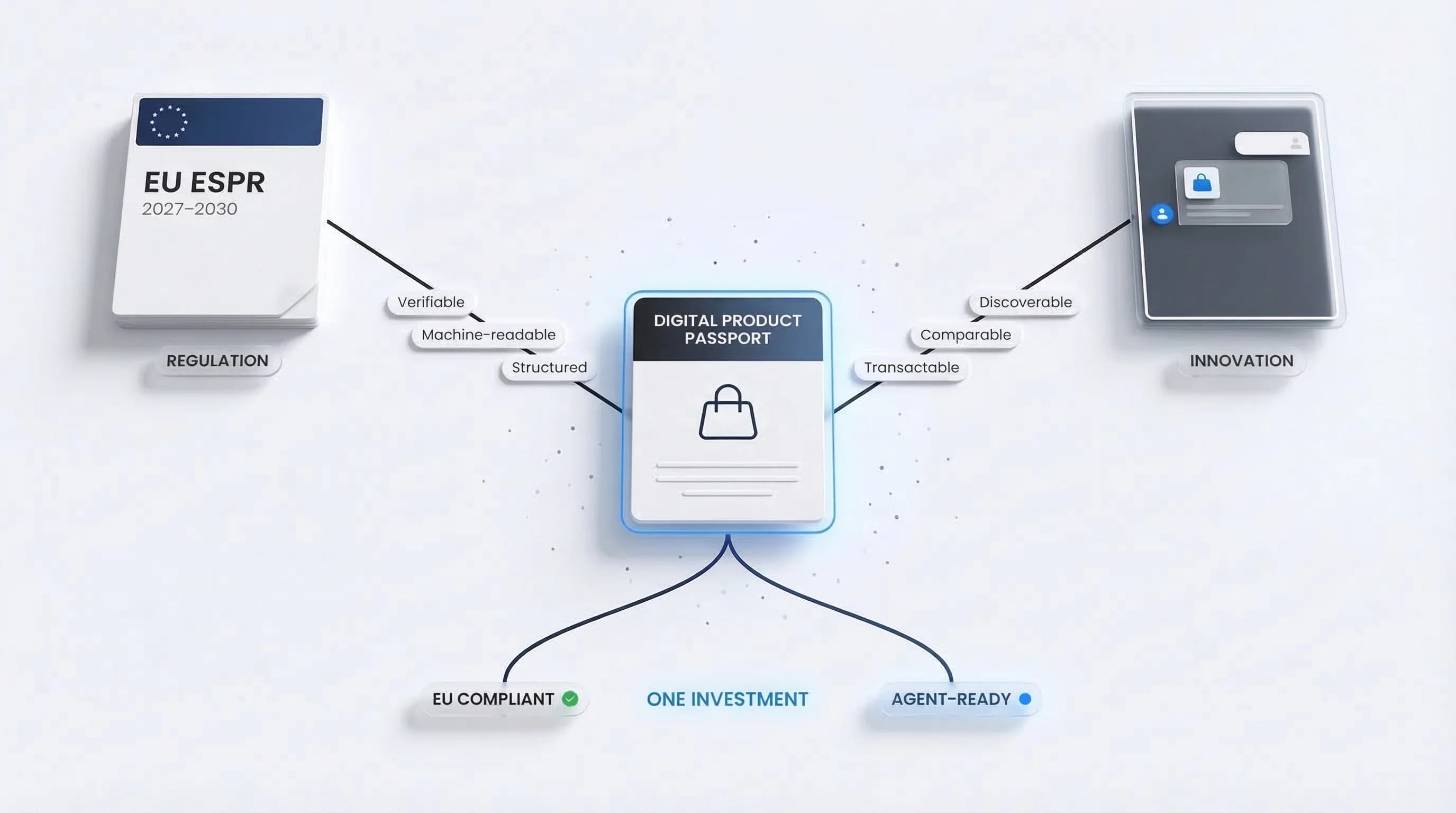
On one side: the EU is mandating verifiable, machine-readable product data for sustainability compliance. On the other: every major commerce platform, payment network, and AI company is building infrastructure for autonomous AI agents that need verifiable, machine-readable product data to function.
One is being driven by regulation. The other is being driven by the market. They’re both arriving at the same destination: every physical product needs a structured digital identity.
The brands that see this convergence will build their data infrastructure once and use it for both. They’ll create Digital Product Passports that satisfy EU regulators and simultaneously make their products agent-ready for the next era of commerce. One investment, two strategic outcomes.
The window is now
Agentic commerce won’t replace human shopping overnight. But the infrastructure is being laid right now, in plain sight, by the companies that control global commerce. Google, Shopify, Amazon, Mastercard, Visa, Stripe. They’ve all moved.
The internet didn’t ask for permission before it restructured retail. AI agents won’t either.
The only question is whether your products will be visible when they do.
James Albarracin is the Founder & CEO of Family Labs, the company behind the Universal Goods Protocol, open infrastructure that gives every physical product a verifiable digital identity. He writes about the intersection of EU regulation, supply chain infrastructure, and the future of physical commerce.